Reimagining Notifications
Duration:
2 weeks, Spring 2020
Worked with:
Solo Personal Sprint
Role:
As the sole contributor, I took on the roles of both User Researcher and Designer.
Tools:
Adobe XD, User Research, Rapid Prototyping
Problem—
Smartphone usage harms our mannerisms and in-person social interactions.
In the US, at least 3 out of 4 people now own a smartphone. As smartphone capabilities continue to grow, many people rely on their smartphones for almost everything. While smartphones keep us connected virtually, research suggests that smartphone usage actually harms our mannerisms and the quality of our in-person social interactions.
Purpose—
Phone usage steals individuals’ ability to fully engaging in the present moment.
Research has shown that smartphone usage leads to less participation in social activities, undermining the value of social interactions. Another study showed phone use is associated with less positive social impressions, lower interaction quality with friends and lower relationship satisfaction with a romantic partner.
Surveys & Interviews—
Phone notifications have both social and anti-social affects.
In 2018, 96% of people in the US aged 18-29 years old owned a smartphone (source). This age group had the highest percentage of smartphone ownership. Within this age group are college students and young professionals. College students compared to adults in the workforce, college students are more likely to be in social situations where they can go on their phones with minimal consequences so I surveyed and interviewed 15+ peers. Interviews conducted during real life situations such as eating a meal, grabbing a drink (coffee, boba, etc).
Goal: learn more about motivations behind using phones in social situations.
Top reasons to use phone in described social situations:
Goal: learn more about motivations behind using phones in social situations.
Top reasons to use phone in described social situations:
- Bored/didn’t want to make conversation (86% of people said)
- Want to stay updated, check notifications (80%)
- Force of Habit (73%)
Secondary Research—
Phone usage prevents individuals from fully engaging in the present moment.
As a Cognitive Science major, I wanted to read the literature and see what I could learn from social experiments already conducted on this topic.
One study found that in a real life cafe setting, people eating with friends enjoyed it less when phones were present, compared to without a phont. Participants said that they felt more distracted when phones were present (source).
Smartphone addiction leads to less participation in social activities so phone usage is undermining the value of social interactions.
Humans need to make a choice to do one thing over another. The value of switching incentivizes change.
Another study showed phone use is associated with less positive social impressions, lower interaction quality with friends and lower relationship satisfaction with a romantic partner (source).
One study found that in a real life cafe setting, people eating with friends enjoyed it less when phones were present, compared to without a phont. Participants said that they felt more distracted when phones were present (source).
Smartphone addiction leads to less participation in social activities so phone usage is undermining the value of social interactions.
Humans need to make a choice to do one thing over another. The value of switching incentivizes change.
Another study showed phone use is associated with less positive social impressions, lower interaction quality with friends and lower relationship satisfaction with a romantic partner (source).
Insights—
Conversation is the most human thing we do.
If you would like to see in-depth how I got these insights and what I did with them, here's the full slide deck.
- Humans are social beings.
- Just having a phone present during a conversation ↓ the quality of the empathic connection people feel and of the conversation because we will anticipate notifications interrupting us.
- Notifications and app content are made to be addictive.
- People don’t care about EVERY notification.
- Humans suck at multitasking.That’s why notifications get us.
Problem, Redefined—
Phones don’t give us an out.
As we have adapted to technology, we have also developed addictions and antisocial habits but technology doesn’t give us an out.
*Note: due to the time limitation of this challenge, I will be focusing only on the role notifications play in terms of these subliminal behavioral changes, however I recognize that there may be other causes to this complex issue.
*Note: due to the time limitation of this challenge, I will be focusing only on the role notifications play in terms of these subliminal behavioral changes, however I recognize that there may be other causes to this complex issue.
Goals—
- User Goal — Regain control over notifications.
- Design Goal — Make tailoring how you receive notifications user-friendly.
- Product Goal — Promote healthier relationship with product.
Ideation—
So, how might we encourage better social habits?
Based on these goals, I wrote additional HMW's:
- make the perceived value of social interaction greater than the perceived value of checking your phone?
- provide a chance to reclaim the ability to engage with the present moment which is lost to digital activity (checking your notifications, browsing an app, etc.)?
- discourage negative social habits in order to promote positive ones
Solution—
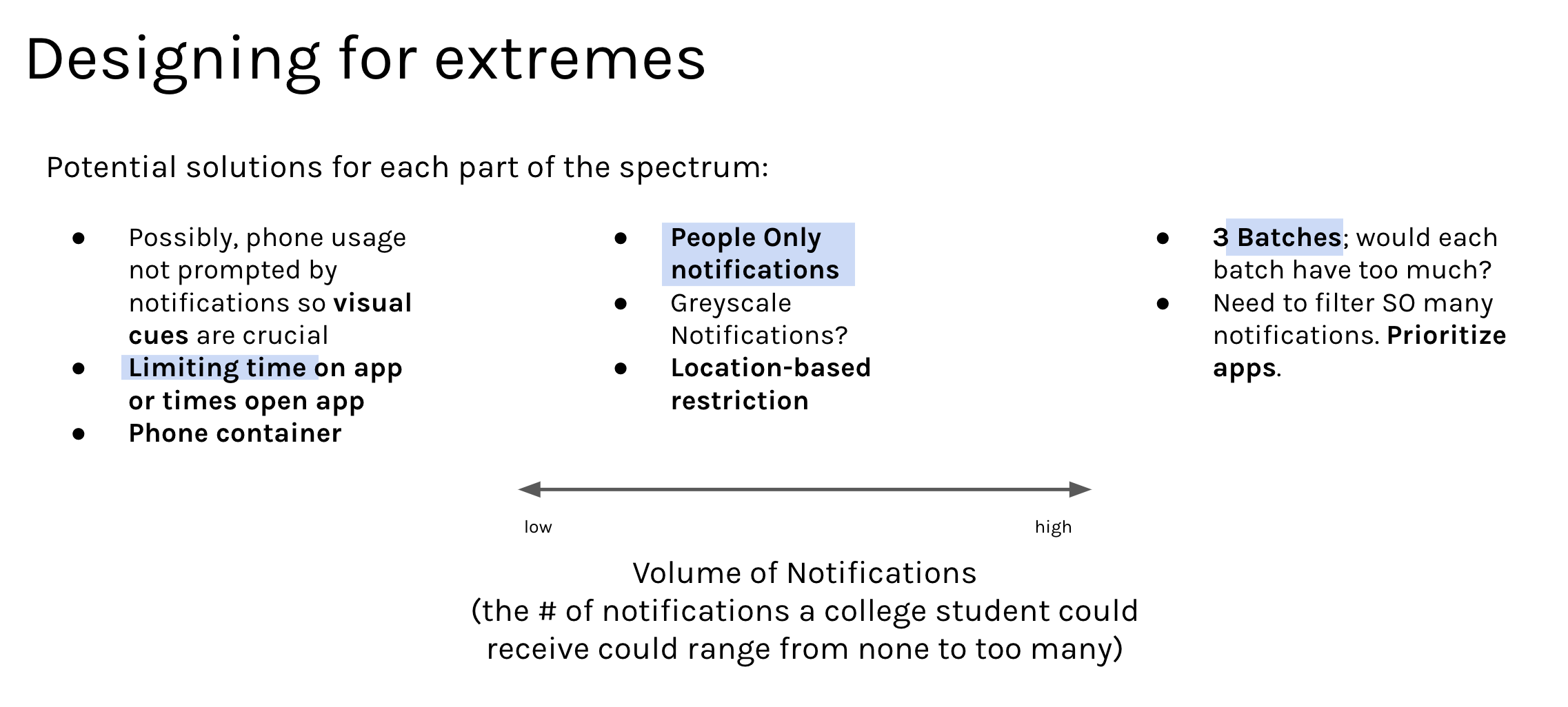
Improve smartphone settings to customize notification preferences.
*Note: I focused on iOS because it turned out Android settings had already had some of the functionalities I wanted to incorporate.
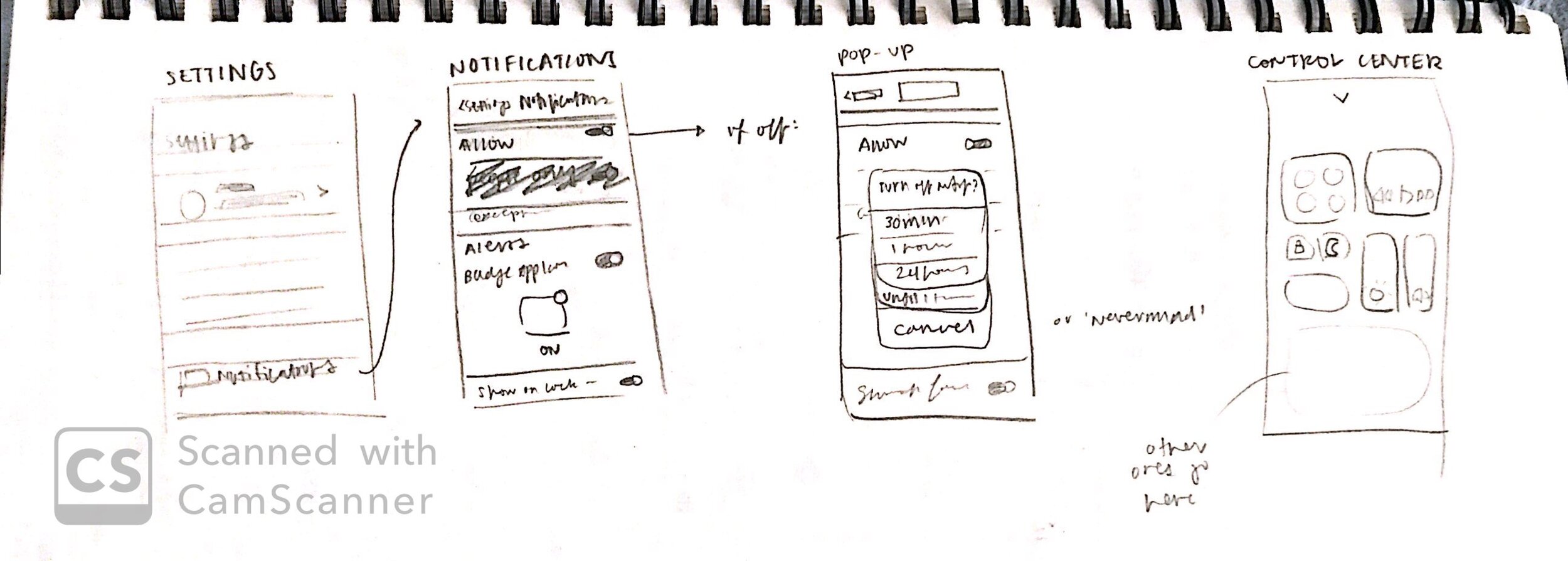
Sketches—
Design Decisions—
Ability to customize the appearance, time frequency, and type of notifications.
I skipped making a mid-fi mockup as I was going to use UI components from Apple's Design System and I didn't intend to redo the layout of iOS Settings, just adding features and ensuring users' understanding of them.
Final Screens—
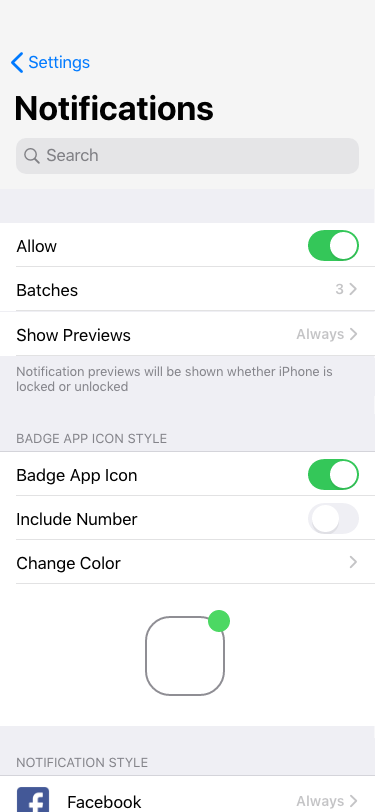
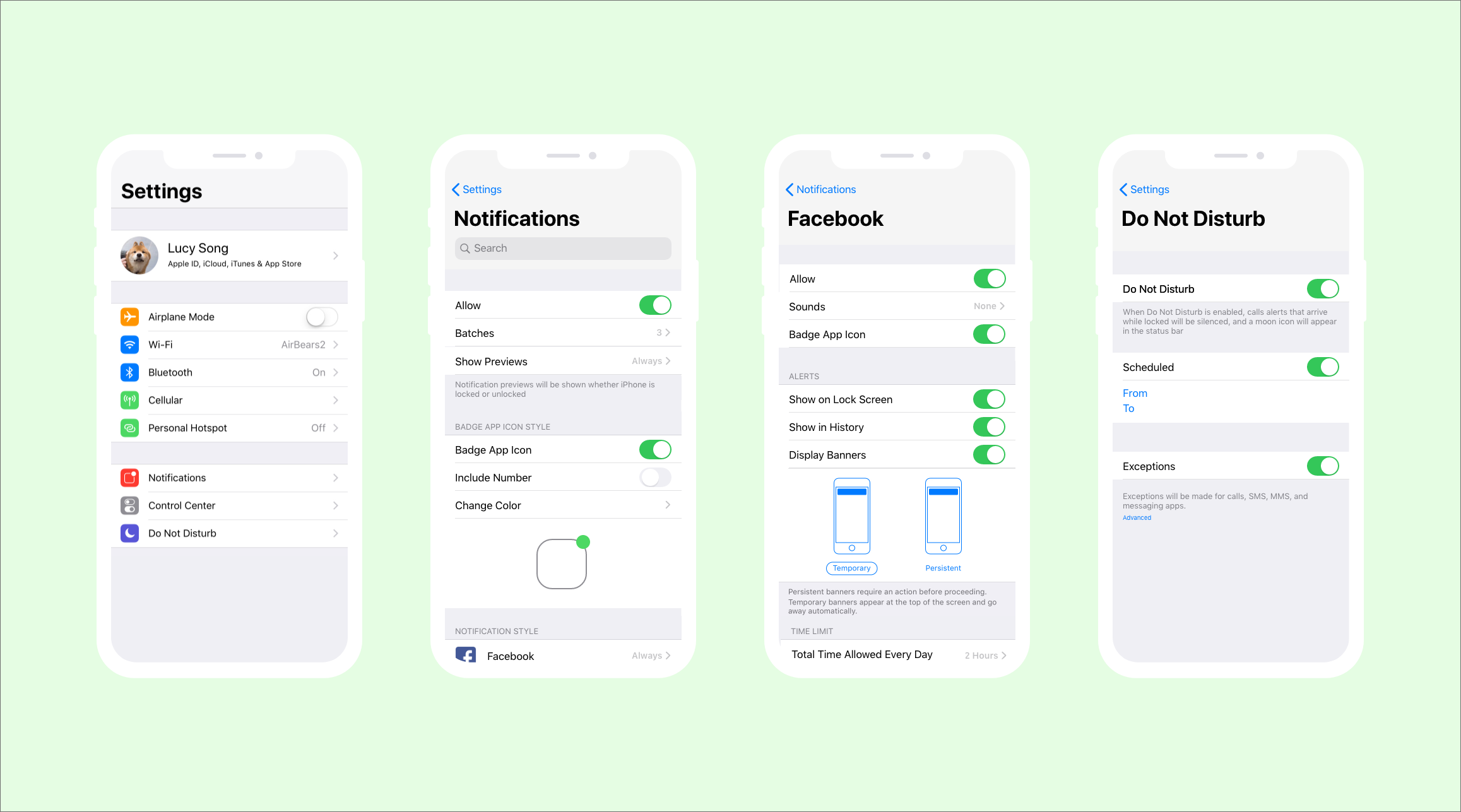
Made the visual of app notifications more customizable. Also added the option to receive notifications in batches. Both features have shown to be less addictive.
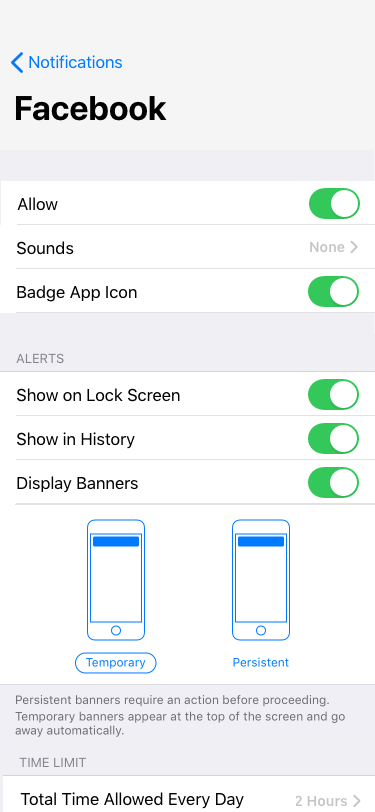
Added a “Total Time Spent” feature so you can receive a pop-up (visual cue) letting you know when to stop scrolling.
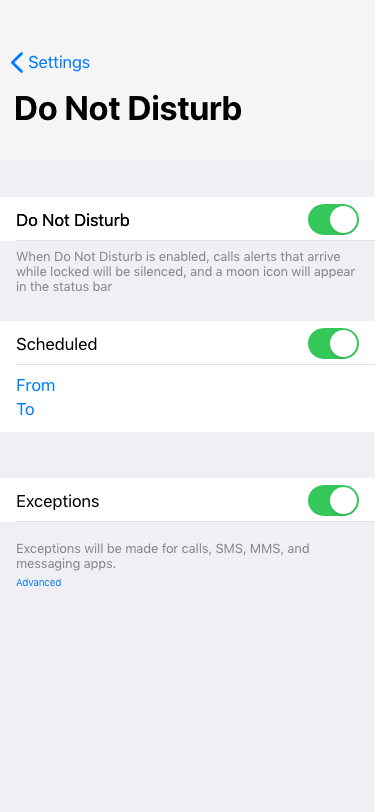
Adapted the existing Do Not Disturb functionality so that you can allow certain app notifications as exceptions. The default are “people-only” apps like email, text, calls, etc. which have been shown to reduct addictability.
Closing Thoughts—
The secondary effects of technology are less thought about.
Given the nature of my solution, it would be difficult to user test without having a working prototype to see how the new notification settings affect users over time. However, if I had the ability, I would’ve loved to as many people I interviewed said they often did not realize they were instinctively going on their phones unless it was pointed out.
I am also curious about how this idea would fit into Apple’s business model and whether they could coexist, but this is my recommendation based on my research.
I am also curious about how this idea would fit into Apple’s business model and whether they could coexist, but this is my recommendation based on my research.